Aug
20
5:00 PM17:00
2026 RILHS Annual Awards Banquet
Join us for the Rhode Island Labor History Society Annual Awards Banquet!
Join us for the Rhode Island Labor History Society Annual Awards Banquet!
Celebrate with us!
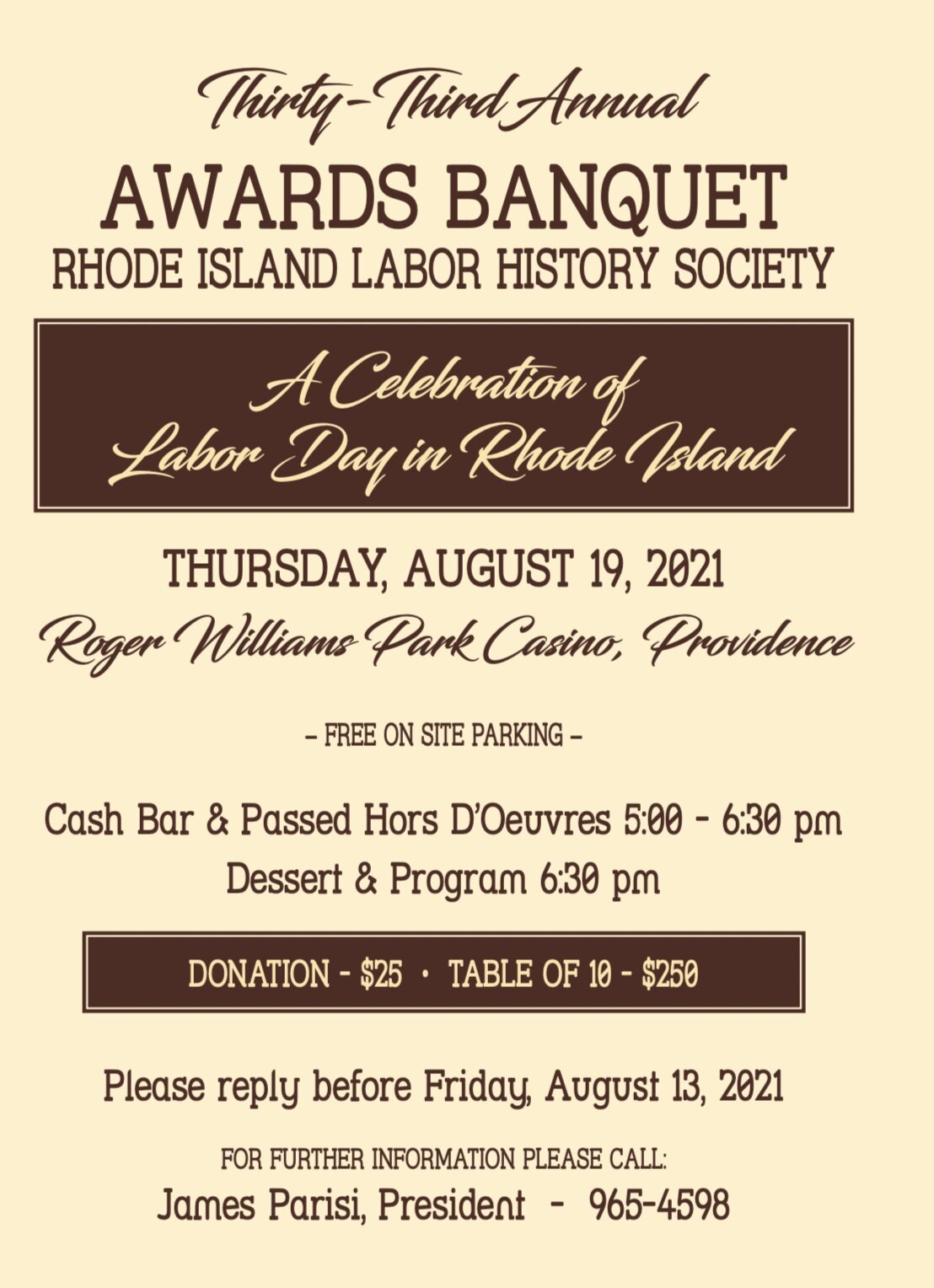
The RI Labor History Society’s thirty-third annual awards banquet is back this fall to celebrate our remarkable labor leaders. We’ll be convening in person on August 19, 2021 at the Roger Williams Park Casino. Cash bar and Hors D’oeuvres at 5PM, dessert and program at 6:30PM. Donation: $25. RSVP by August 13, 2021.
Aaron Bekemeyer, Doctoral Candidate, Harvard University
This talk will examine the case of Baltimore in the 1960s and ‘70s, where two unions (AFSCME and the Fraternal Order of Police) went head-to-head to represent the officers of the city police department. This history will shed light on the relationship between police unions and the labor movement as a whole and reveal the contested, contingent, dynamic nature of that relationship over time.
Patrick Crowley, NEA-RI
In 1934, workers across Rhode Island went on strike as part of one of the largest industrial actions in American history – the General Textile Strike. In the mill village of Saylesville, workers fought with deputy sheriffs and eventually the national guard. Two workers were killed in an event known as “The Saylesville Massacre.”
Andrew Polta, Public Archaeology Lab
Click here to join via Zoom: https://aflcio.zoom.us/meeting/register/tJYlfuigrDksHdfNWxIhXjycaQ7UEIrsDH6T
The conditions of men’s labor in a port like Providence pushed many women into the labor market during the early decades of the nineteenth century. Forced to provide a significant portion of their family’s income, these women faced a dilemma: prevailing gender norms depressed wages for the most readily available jobs, and truly lucrative work was often illicit, if not illegal. Both types of labor left women vulnerable to removal by the Providence Town Council, as either unwanted paupers or disorderly vagrants. Drawing on hundreds of interviews the town council conducted with ordinary Providence residents, we can reconstruct these women’s responses to their situation. The records show women who stubbornly refused to give up lives they had built for themselves and who formed neighborhood networks to help evade the attentions of Providence authorities. At the center of these networks were so-called disorderly houses, female-run boarding houses or brothels, which provided everything from work opportunities to a place to hide to even rudimentary social services for women in need.
Christy Clark-Pujara, PhD, University of Wisconsin-Madison
Drawing from her book Dark Work: The Business of Slavery in Rhode Island (NYU Press, 2016), Dr. Clark-Pujara will examine how the business of slavery— economic activity that was directly related to the maintenance of slaveholding in the Americas, specifically the buying and selling of people, food, and goods— shaped the experience of slavery, the process of emancipation, and the realities of black freedom in Rhode Island from the colonial period through the American Civil War.
For further details, visit us on Facebook.